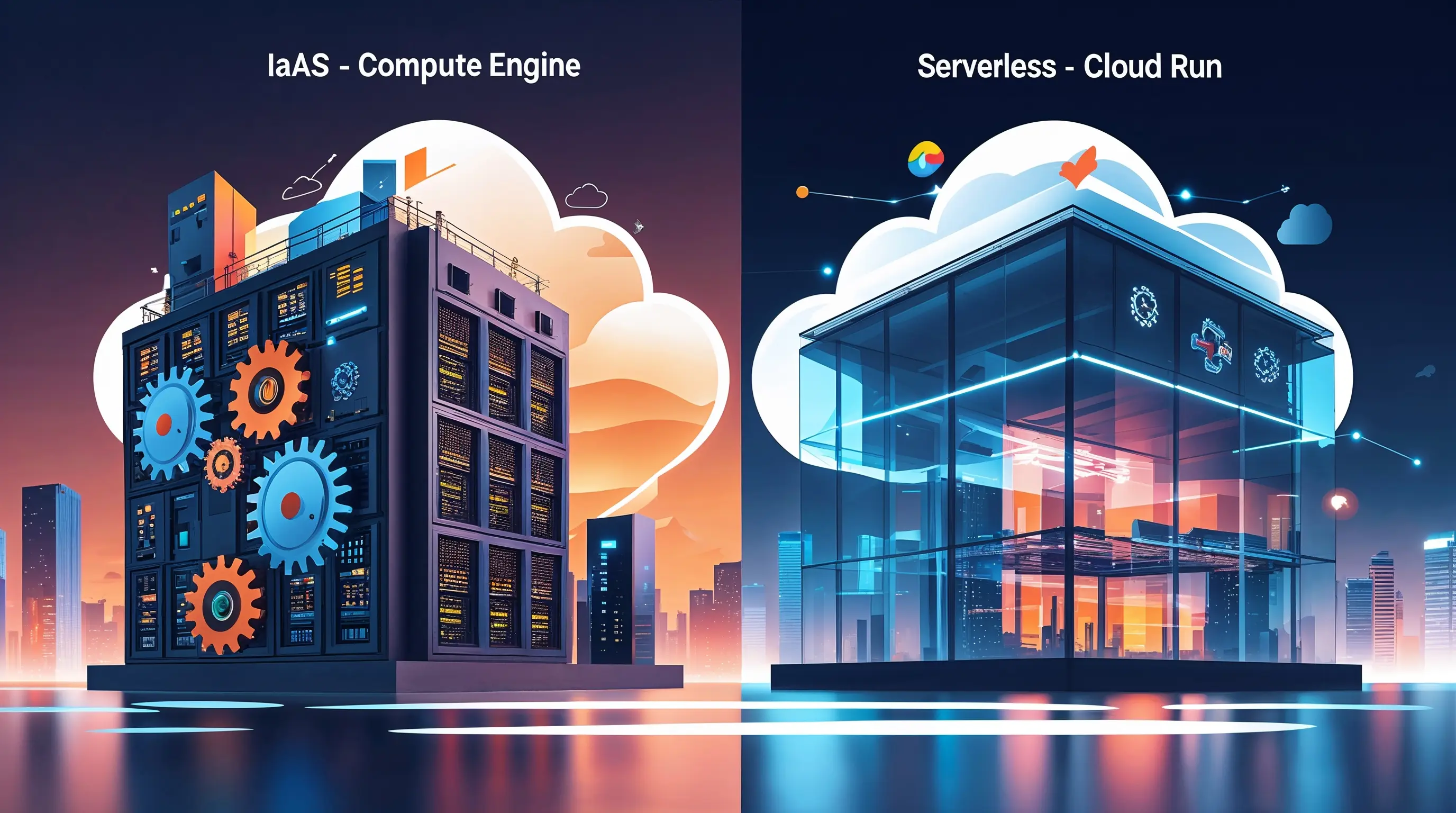
When I discuss cloud migration with my clients, the first question is rarely "How much does it cost?" but rather, "How do I maintain control?" Many fear losing authority over their infrastructure when moving to the cloud. The truth is, the cloud doesn't strip away control; it simply changes the nature of your "maintenance work."
To better visualize these differences, I like to use a simple analogy.
The Real Estate Analogy
Imagine you want to open an office in Frankfurt:
-
Compute Engine (IaaS): It’s like renting an entire house. You have total control. You decide on the walls, the furniture, the electrical system, and the security setup. But if the roof leaks or the plumbing breaks, the responsibility is yours. You must handle OS patches, performance monitoring, and manual scaling. It is a powerful choice, but it requires a constant "caretaker."
-
Cloud Run (Serverless): It’s like renting a room in an elite coworking space. You bring only your laptop and your ideas (your containerized code). Everything else—building security, heating, structural maintenance—is handled by the provider. If you suddenly need ten desks instead of one, the system creates them for you instantly.
Why I chose Cloud Run for my portfolio
Many ask me, "Giuseppe, why would an Architect prefer a 'serverless' solution?" The answer lies in the value of my time.
As a professional, I want to focus on creating innovative features, like the AI agents I am integrating into this site, rather than spending half my day managing the Linux kernel of a VM. Cloud Run offers me three competitive advantages:
-
Zero Maintenance: I don't have to handle security patches or system updates.
-
Real Scalability (Scale-to-Zero): If no one visits the blog at 3:00 AM, the system "shuts down," reducing costs to zero. I don't pay for idle capacity.
-
Deployment Velocity: My release cycle is strictly tied to my code, not to infrastructure management
When the "Whole House" is still the right choice
Let’s be clear: there is no magic wand. If your business has legacy workloads, specific hardware driver requirements, or deep-level network architecture needs, Compute Engine remains an essential tool.
The secret to a good Architect isn't just using the latest technology; it’s choosing the one that maximizes the client's return on investment.
Conclusion
The cloud isn't just a "place to put files." It’s a mindset shift. The question you should ask yourself today isn't "Where do I host my software?", but "Where do I want my team to invest their energy?"
If your goal is innovation, stop worrying about the "roof of the house" and start focusing on how to furnish the room of your success.